Sushi Rice (Short-Grain), Rice-Cooker Style
Kitchen-tested
Taiwanese homes cook rice in a steam rice cooker: a cup of water in the outer pot, rice in the inner, and when the water is gone the rice is done. The two containers are that cooker. Glossy, springy grains, and it cannot scorch.
Ingredients
- — First-in batch · rice soak —
- 200 g sushi rice (white short-grain), rinsed until the water runs clear
- Water to the 260 ml mark: put the rinsed rice in the 1.0 L and pour water in to 260 ml total on a jug scale (rinsed rice already carries about 35 ml)
- ¼ tsp salt (optional — Taiwanese daily rice is unsalted), stirred through the water
- — Second-in batch · jacket water —
- Jacket: 250 ml water, poured into the 1.6 L (generous on purpose — the timer does the timing, the spare water is your forgiveness buffer)
Method
- Rinse the rice until the water runs clear. Put it in the 1.0 L, add water to 260 ml total (rinsed rice already holds about 35 ml of it; 200 ml for 150 g), add the salt if using, and soak 20–30 minutes. No time to soak? Skip it — you will rest the rice longer at the end (step 5).
- Wipe the base of the 1.6 L bone-dry. Pour the 250 ml jacket water into the 1.6 L and lower the 1.0 L of rice into it — no lid on the 1.0 L. Rest the 1.6 L lid loosely over both, upside down (rim up) so it drips less.
- Medium heat — about 6 of 9 on an induction hob, level 2 on a portable hob (see Heat below) — and set a timer for 25 minutes. Get on with your evening: the rice cannot scorch, and rattling sounds are normal. If you ever hear a single metallic clunk and the rattling stops, the jacket has run dry — turn the heat off then.
- When the timer goes off: turn off the heat, then set another timer for 12 minutes. (Skipped the soak? Then steam for 35 minutes instead of 25 and rest just 5 minutes — the 250 ml jacket lasts.) Leave everything exactly where it is — the warm bath keeps the rice perfect while it rests, and will not overcook it.
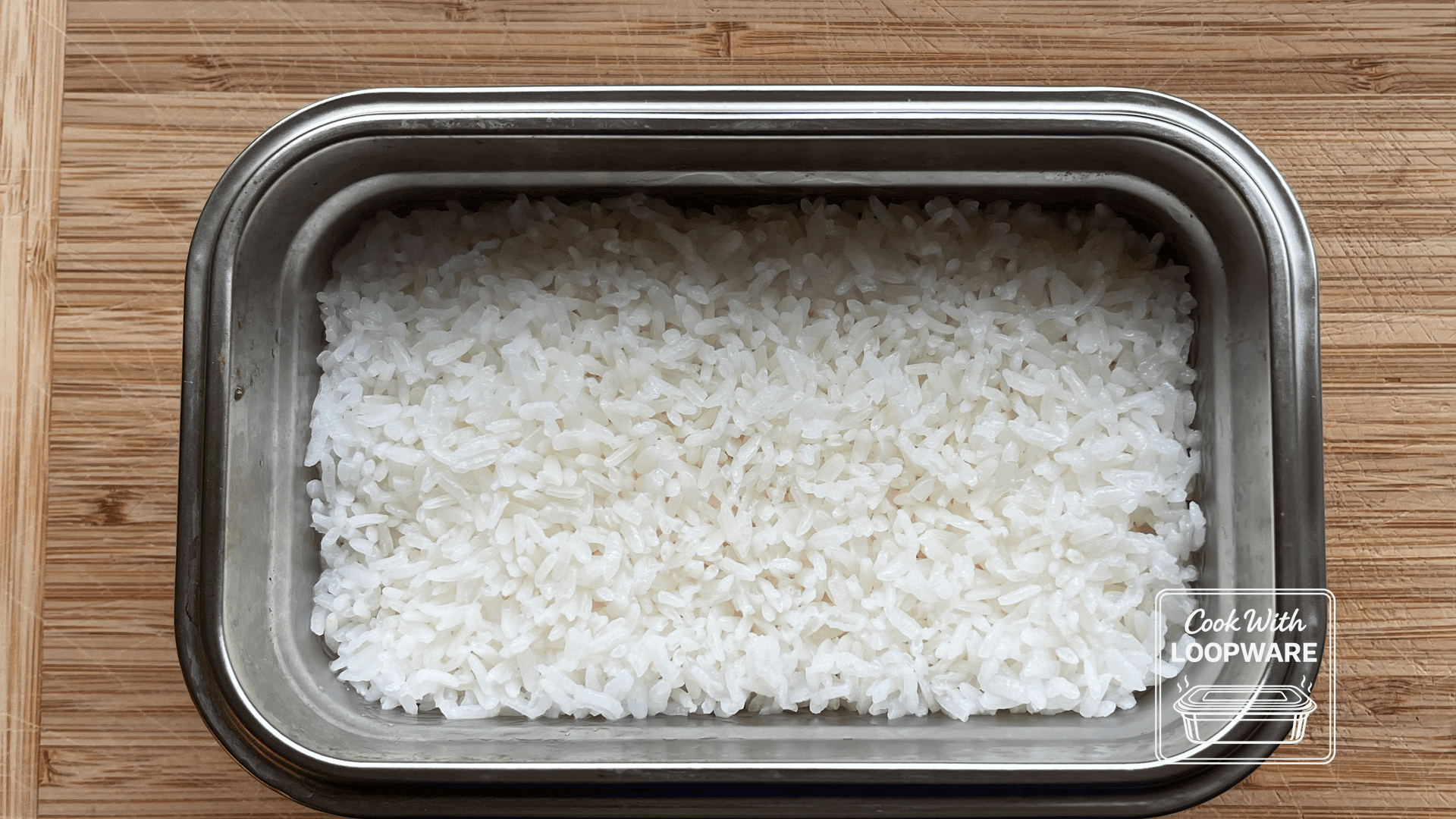
- When the second timer goes off, lift the inner pot out with tongs or a dry cloth. Fluff: glossy, tender-springy, zero standing water.
- To reheat: storage lid off, cooking lid on loose. From the fridge, sprinkle a tablespoon of water over the rice and break up the clumps with a fork, then medium heat — about 6 of 9 on an induction hob, level 2 on a portable hob — and set a timer for 6 minutes; when it goes off, fluff it: it should be steaming and piping hot right through. From frozen, two tablespoons of water over the block, the same medium heat, and set a timer for 10 minutes; when it goes off, break the block apart with a fork, lid back on loose and set a timer for 4 minutes more, until the rice is fluffy, steaming and piping hot right through.
Heat
| Stage | Heat into the pan | Induction hob (settings 1–9) | Portable induction hob | What to look for |
|---|---|---|---|---|
| Steam (water jacket) | about 330–450 W | about 6 of 9 (medium) | level 2 (the 300 W setting) | the water jacket at a lively simmer; the lid rattles gently |
Hob settings are not standard — the same number means different heat on different hobs. The power figures show how hard the pan is actually being heated. The settings shown are for a typical fitted induction hob with settings 1–9, and for a plug-in portable induction hob with power settings. Go by what you see in the pan, then remember the setting that gave it on your own hob.
Cook’s checks
- When the timer goes off and after the rest: glossy, springy grains and no standing water.
- Forgot the timer? The 250 ml jacket gives about 15 minutes' grace before it runs dry — and if you hear a single metallic clunk and the rattling stops, that is the jacket finishing: just turn it off. Rice firm after the rest: sprinkle 30 ml boiling water over it, lid back on, 5 more minutes on the same heat — and add 2 minutes to the timer next time. Standing water: use 10 ml less inside next time. Skipped the soak? Steam 35 minutes (the 250 ml jacket lasts) and rest 5 — done. (Cooked 25 by mistake without a soak: leave the inner pot in the hot bath, heat off, up to 35 minutes — it finishes there.) Brown or mixed grains: this recipe is for white sushi rice; whole grains stay hard in this timing — use the Mixed-Grain Rice recipe.
- Cook with the cooking lid loose or vented; never heat with a friction-fit storage lid sealed. Both containers, the lid and the jacket water are scalding — lift the inner pot with tongs or a dry cloth and let the 1.6 L cool before emptying it.
Nutrition
| Serving | Calories | Protein | Fat | Saturates | Carbohydrate | Sugars | Fibre | Salt / sodium |
|---|---|---|---|---|---|---|---|---|
| 1 serving | 347 kcal | 6 g | 1 g | 0.1 g | 79 g | 0.0 g | 0.0 g | 0.3 g sodium (0.8 g salt) |
Nutrition information is provided for general reference only. Values are estimates based on typical ingredient data and will vary with brands, cuts, portion sizes and preparation. They are not intended as precise nutritional, dietary or medical guidance.